
Processing
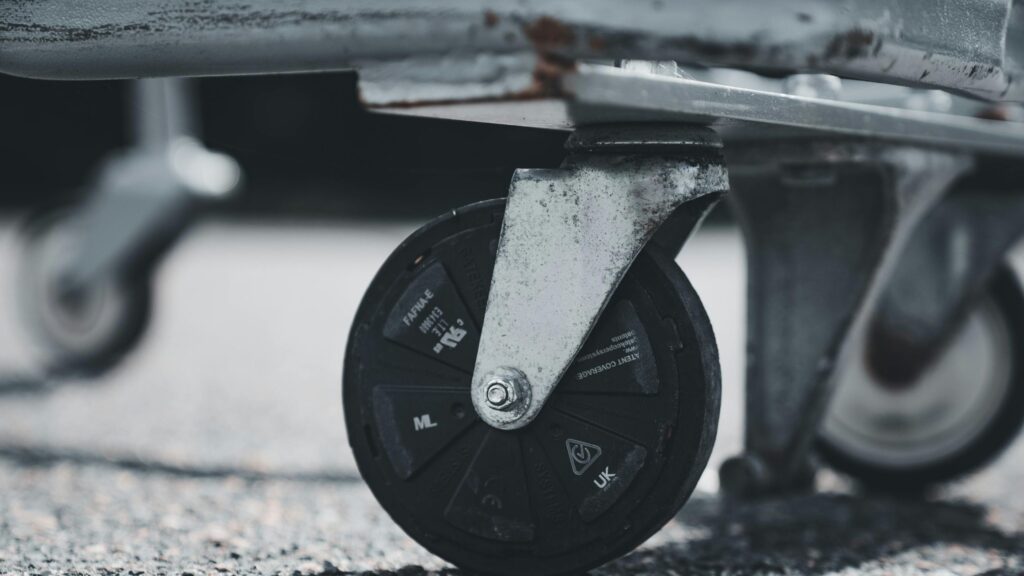
Wheels for industrial carts are the direct point of contact between the cart and the pavement: as such, they decisively influence the movement of loads, stability and the duration of the entire procedure.
In industrial environments, where the carts are subject to intensive cycles and high loads, it is fundamental that the wheels guarantee optimal performance.
In this article, we present the main types and quality requirements.
Each type of cart has specific needs and requires targeted solutions.
In these and other contexts, an incorrect choice of wheels can translate into greater struggles for the operators, premature wear of components and increased work site risk.
What do cart wheels need to be in order to be truly functional in industrial processes?
One of the most important aspects is smoothness, which directly influences operative efficiency and operator comfort. Well-designed wheels reduce the force necessary to start and maintain the movement of the cart or hand truck, allowing fluid movement with even heavier loads, resulting in greater productivity and lower physical effort during daily operations.
A factor that shouldn’t be underestimated is noise. In closed industrial environments, like manufacturing facilities or warehouses, the noise generated by the movement of carts can negatively impact operator well-being. The use of proper materials for the treads, like polyurethane or technical rubber, allow reduction of vibrations and noise, improving the quality of the work environment.
Inadequate wheels can cause slippage, sudden blocks or loss of cart control, with consequent risks to operators and the goods being transported. Anti-slip materials and treads designed to guarantee good adherence to the surface contribute to reducing accident risk.
The stability of the cart is tightly linked to the quality and configuration of the wheels. Wheels designed to correctly distribute the load ensure a uniform ground support, avoiding oscillations or roll-overs, especially when stopping or changing direction. Elevated stability improves control of the cart even in the presence of heavy or bulky loads, making the operations more precise and secure.
The question, therefore, is: how can we create wheels for industrial carts able to meet this need?
Without suitable metal parts production, even the highest performing wheels risk losing efficiency and stability. Pins, bushings, spacers, screws, nuts and fastening systems allow correct wheel function and safety over time.
Within the structure of the wheel, metal parts are used to guarantee the correct assembly between hub, support and rotation systems. The pins ensure fluid movement, the bushings reduce friction and wear, while the screws and fastening systems maintain the stability of the structure even in the presence of heavy loads and continuous stress. In industrial contexts, where carts often operate in dangerous conditions, these components must guarantee mechanical strength and dimensional accuracy.
Therefore, the quality of the parts directly influences the smoothness, security and dependability of the wheel.
This is why choosing quality metallic parts is indispensable to ensuring constant performance and long operative life of industrial cart wheels.
